On most sealed systems, the boiler pressure gauge should read roughly 1.0 to 1.5 bar when the heating is off and cold. Some manufacturers quote about 0.5 to 1.0 bar for a cold system, so the figure in your own boiler manual is always the exact one to follow. When the heating runs, the water inside expands and the pressure naturally rises a little to around 2.0 bar. If the pressure falls well below the figure in your manual, the boiler may stop working and you may have no heating or hot water.
Central heating systems need a specific amount of water inside them to carry heat from the boiler to your radiators. In a modern sealed system, this water is kept under pressure so it can be pumped efficiently around the house. Older regular boilers often use a separate feed and expansion tank in the loft to gravity feed the water, but most modern combi and system boilers are sealed and rely on this internal pressure.
Keeping the pressure at the correct level ensures your heating runs smoothly and efficiently. When the pressure is too low, the boiler safety sensors will shut the system down to prevent damage to the internal pump. When the pressure is too high, the system is forced to expel the excess water to stop the pipes from bursting.
How to read the pressure gauge
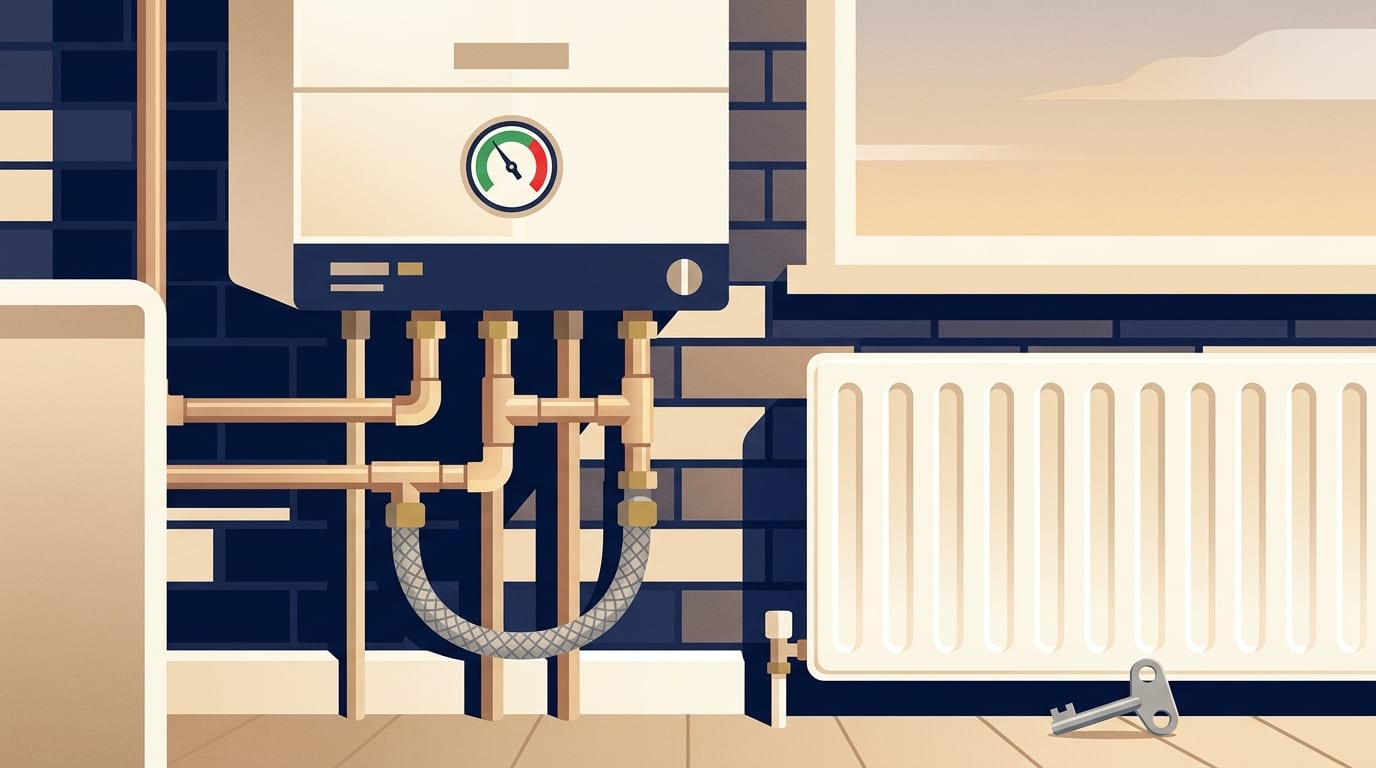
You can usually find the pressure gauge on the front of your boiler, sometimes hidden behind a small drop down flap. It measures the water pressure in a metric unit called bar. One bar is roughly equal to the normal atmospheric pressure around us. On many mechanical dials, the ideal cold pressure range of 1.0 to 1.5 bar is marked out clearly as a green zone.
Some modern boilers have a digital screen instead of a mechanical dial. You may need to press a button to display the pressure reading on the screen, and the exact steps for this will be detailed in your manufacturer instructions. Whether digital or mechanical, the gauge is your main tool for understanding the health of your heating system.
A reading above 2.5 bar is a warning sign that the system is over pressurised. A reading near 3.0 bar is too high. This is the danger zone where a safety component called the pressure relief valve automatically opens. It lets water out through a small pipe to protect the boiler from damage, and this discharge pipe is usually routed through an outside wall.
Why boiler pressure drops
Low boiler pressure is commonly caused by leaks in the system. The water might be escaping from wet joints at your radiators, dripping from the radiator valves, or leaking from the exposed pipework around the house. Sometimes a leak is hidden under the floorboards, and you might only notice it when ceiling stains appear in the rooms below. If you suspect a hidden problem, knowing how to detect a water leak is a useful first step.
Recently bled radiators are another very common reason for a drop in pressure. When you use a radiator key to let trapped air out of a cold radiator, you are reducing the overall volume inside the sealed system. This releases water and air, which naturally lowers the pressure reading on the gauge.
Pressure loss can also be caused by failed components or degraded internal seals. A faulty pressure relief valve might start letting water out even when the pressure is safe. You can often spot this if there are drips coming from its outlet pipe on the outside wall, while a healthy and dry pipe is normal. Pump problems can also lead to pressure issues within the boiler casing.
One of the most significant internal failures is a broken expansion vessel. This metal tank contains a rubber diaphragm that separates the system water from a pocket of compressed air. If this diaphragm fails, there is nothing to absorb the expanding water, so the pressure climbs as the system heats up, the relief valve lets water out, and the pressure then drops when the heating cools down.
Why boiler pressure goes too high
The most frequent cause of high boiler pressure is simply adding too much water when repressurising the system. It is very easy to turn the filling loop valves too far and overshoot the green zone on the gauge. If you lose concentration while topping up, the pressure can quickly climb past 2.0 bar and approach the danger zone.
A filling loop left partly open will also cause the pressure to rise steadily. The filling loop connects your mains cold water supply to the heating system. If the valves are not closed tightly after you finish topping up, mains water will continue to push its way into the boiler, driving the pressure gauge higher and higher.
A faulty pressure relief valve can sometimes stick or fail to operate correctly, leading to unpredictable pressure readings. If the pressure is near 3.0 bar and keeps rising, turn the heating off and call a Gas Safe registered engineer.
An expansion vessel with the wrong balance of air and water will also push the pressure too high. Over time, the compressed air inside the vessel can slowly leak away. Without this cushion of air to absorb the expanding hot water, the pressure gauge will climb rapidly the moment the heating turns on.
Topping up or lowering the pressure
Many combi and system boilers can be topped up through a filling loop. This is usually a silver braided hose with a small valve at each end, located underneath the boiler. Some modern boilers have an internal filling key instead of a hose. The manufacturer instructions for your exact model will explain how to operate the loop safely.
The manual also gives the pressure to aim for on your boiler. Anyone who is not confident topping up should ask a heating engineer to help.
If too much water has gone in, bleeding a radiator releases water and lowers the pressure. Do this only with the heating off and the radiators cool, and follow the manufacturer's instructions for your system.
You should never attempt to adjust the internal components yourself. You must never remove the boiler casing, touch the pressure relief valve, or attempt to recharge the expansion vessel.
When the pressure keeps dropping
Needing to top up the boiler again and again points directly to a leak or a failing part. A healthy sealed heating system should hold its pressure without regular topping up. If you find yourself reaching for the filling loop every week, there is an underlying fault that needs to be diagnosed.
Repeatedly adding plain mains water to the system causes a secondary problem. Central heating systems contain a chemical called a corrosion inhibitor, which stops the inside of the radiators and pipes from rusting. Every time you top up the boiler with fresh mains water, you dilute this vital corrosion inhibitor.
Once the inhibitor is too diluted, corrosion can build up as sludge in the radiators and pipework, which can block the boiler's heat exchanger. The system then needs a specialist to drain and refill it properly.
Homeowners should only look for visible leaks outside the boiler, such as checking the radiator valves and the exposed pipework. Never remove the boiler casing yourself to find the source of a leak. A Gas Safe registered engineer should inspect it safely.
Signs of a faulty expansion vessel or relief valve
A faulty expansion vessel or relief valve often shows one or more of these signs:
- Pressure that climbs sharply when the heating runs and drops when it cools
- Pressure rising towards 3 bar followed by water from the pressure relief valve pipe
- A dripping relief valve outlet after heating cycles
- Needing to repressurise the system every few days or weekly
- A reading above 2.5 bar on the gauge
When to call a Gas Safe registered engineer
By law, anyone employed to work on gas appliances in homes must be a Gas Safe registered engineer. Never attempt gas work yourself. The engineer carries an ID card that shows exactly which types of gas appliance they are qualified to work on. You can check their registration by calling the Gas Safe Register on 0800 408 5500, looking on their website, or by texting Gas plus the engineer's seven digit licence number to 85080.
You should call a Gas Safe registered engineer if the pressure rises again after bleeding the radiators, or if it drops to zero completely. You also need a professional if you suspect an internal part may have failed, or if the pressure relief valve keeps discharging water outside. These internal parts should not be serviced by homeowners.
If you ever suspect that your gas appliance is unsafe, it is illegal to continue using it. You must turn the appliance off immediately and do not use it until a Gas Safe registered engineer has checked it thoroughly. If you smell gas, you should ventilate the property and call the gas emergency number on 0800 111 999, or 0800 002 001 in Northern Ireland.
What pressure repairs typically cost
Repairs and small jobs are usually charged by the hour or as a minimum charge. This often includes a call-out fee that covers the first hour of work at the property. Evenings, weekends and bank holidays usually carry a premium rate. The diagnostic visit is usually included in the final bill if the repair goes ahead.
Most common boiler repairs take one to two hours to complete once the engineer has diagnosed the fault. Larger jobs, such as replacing a heat exchanger, may need a second visit to fit the new parts. Most expansion vessel jobs take one to three hours. Emergency or out-of-hours visits typically cost £120 to £300 plus parts, while the same emergency visit in London and the South East costs £150 to £400 plus parts.
The table below shows typical prices for common boiler repairs.
|
Repair type |
Typical price range including VAT |
|---|---|
|
Thermostat or sensor |
£120 to £250 |
|
Ignition or pilot light |
£150 to £300 |
|
Fan |
£200 to £400 |
|
Pump |
£250 to £450 |
|
Diverter valve |
£250 to £450 |
|
Expansion vessel or pressure fault |
£150 to £350 |
|
PCB (main circuit board) |
£300 to £550 |
|
Heat exchanger |
£400 to £700 or more |
|
Frozen or leaking condensate pipe |
£80 to £200 |
These figures are typical published prices for 2026, and your local quotes will differ based on the exact fault and your location. For most general repairs, you can expect to pay £150 to £400 in the rest of the UK, and £200 to £500 in London and the South East. You can read more about these wider costs in our guide to boiler repair costs.
The table below shows typical prices for expansion vessel repairs and replacements.
|
Expansion vessel job |
Typical price range |
|---|---|
|
Recharging the vessel |
£80 to £180 |
|
Replacing an external or add on vessel |
£180 to £350 |
|
Replacing an internal vessel |
£250 to £450 |
|
Complex installations |
£450 to £600 or more |
These figures are typical published prices for 2026, and your local quotes will differ based on the complexity of the job and whether the vessel is inside the boiler casing or mounted externally on the wall.
Getting a quote and your consumer rights
When you hire a heating engineer for a specific job like a boiler replacement or fitting new fixed parts, the work is usually quoted as a fixed price. A quote is a fixed price that cannot change unless you agree to extra work. An estimate is not fixed, and the final bill can go up if the job takes longer than expected.
A proper written quote should contain several specific details to protect you. It should include a clear description of the exact work to be carried out. It must confirm whether VAT is included in the final figure. It should also give a breakdown of the parts and materials being supplied, and details of the warranty provided for those new parts.
Under the Consumer Rights Act 2015, any service must be carried out with reasonable care and skill. If the work is poor, the customer can ask for it to be put right at no extra cost. Services arranged by phone, online or at home usually carry a 14-day cooling-off period. However, this cooling-off period does not automatically apply to urgent repairs that the customer has specifically asked for. You can find official guidance on these general rights through Citizens Advice.
Common questions
How do you reduce boiler pressure?
You can reduce boiler pressure by bleeding your radiators. Using a radiator key to open the bleed valve releases trapped air and water from the sealed system, which lowers the pressure gauge. If the pressure rises again after bleeding, there may be a fault such as a filling loop letting water in or an expansion vessel problem, so call a Gas Safe registered engineer.
What is the boiler pressure relief valve?
The pressure relief valve is a vital safety device inside your boiler. If the system pressure gets too high and approaches 3.0 bar, the valve automatically opens to discharge water and protect the internal pipes from bursting. This water is usually sent out through a small copper pipe on an outside wall.
Why is my boiler losing pressure with no visible leak?
If your boiler is losing pressure but you cannot see a leak, the water might be escaping from pipework hidden under your floorboards. Alternatively, an internal component like the expansion vessel may have failed, or the pressure relief valve might be letting water out through the external pipe while you are not looking.
Is low boiler pressure dangerous?
Low boiler pressure is not usually dangerous, but it will stop your heating from working. Modern boilers have a sensor that shuts the boiler down when the pressure falls too low, to protect the pump and other parts. However, the underlying cause of the low pressure still needs to be found and fixed.
Next steps
If you are worried about the pressure in your heating system, there are a few simple checks you can do before calling an engineer. Work through this short checklist to gather the facts:
- Check the pressure gauge while the heating is completely off and cold
- Read your boiler manual to find out the correct cold pressure for your exact model
- Look for visible leaks around your radiator valves and exposed pipework
- Check the outside pressure relief valve pipe for signs of dripping water
- Follow the manufacturer instructions if you need to safely top up or bleed the system
If you need to repressurise the system constantly, or you suspect an internal part has failed, you will need a qualified professional to safely diagnose the fault. To get your heating system checked and repaired safely, you can find a local plumber near you today.
Find a top rated plumber near you
4,869 plumbers across the UK, each ranked on their Google rating and the number of reviews behind it. Start with your county: