Most boiler repairs in the UK cost between £150 and £400 in 2026, including VAT and labour. If you live in London or the South East you will typically pay between £200 and £500 for the same work. The exact price depends on what has broken, how much a replacement part costs and whether you need an engineer to visit outside normal working hours.
How much does a boiler repair cost?
When your boiler stops working, the first step is finding out why. Engineers usually charge a call-out or diagnostic fee for this initial visit. This covers their travel time and the work required to test the boiler safely and identify the fault. If you agree to go ahead with the repair they quote for, this diagnostic fee is usually absorbed into the final bill.
Once the engineer knows what is wrong, many common repairs take one to two hours to complete. If the fault is straightforward and the engineer carries the right part in their van, they can often fix it on the spot. Larger jobs or repairs that need a part ordered from a supplier may need a second visit.
The table below shows typical 2026 prices for common boiler repairs. These figures include the part, the labour to fit it and VAT.
|
Boiler part or fault |
Typical repair cost |
|---|---|
|
Frozen or leaking condensate pipe |
£80 to £200 |
|
Thermostat or sensor |
£120 to £250 |
|
Ignition or pilot light |
£150 to £300 |
|
Expansion vessel or pressure fault |
£150 to £350 |
|
Fan |
£200 to £400 |
|
Pump |
£250 to £450 |
|
Diverter valve |
£250 to £450 |
|
PCB (main circuit board) |
£300 to £550 |
|
Heat exchanger |
£400 to £700 or more |
These figures are typical published prices for 2026, and local quotes will differ depending on your boiler model and where you live.
Common boiler faults and what they mean
Boilers are complex machines with many moving parts and safety systems. When an engineer diagnoses a fault, they will usually name a specific component that has failed. Understanding what these parts do can help you make sense of the quote.
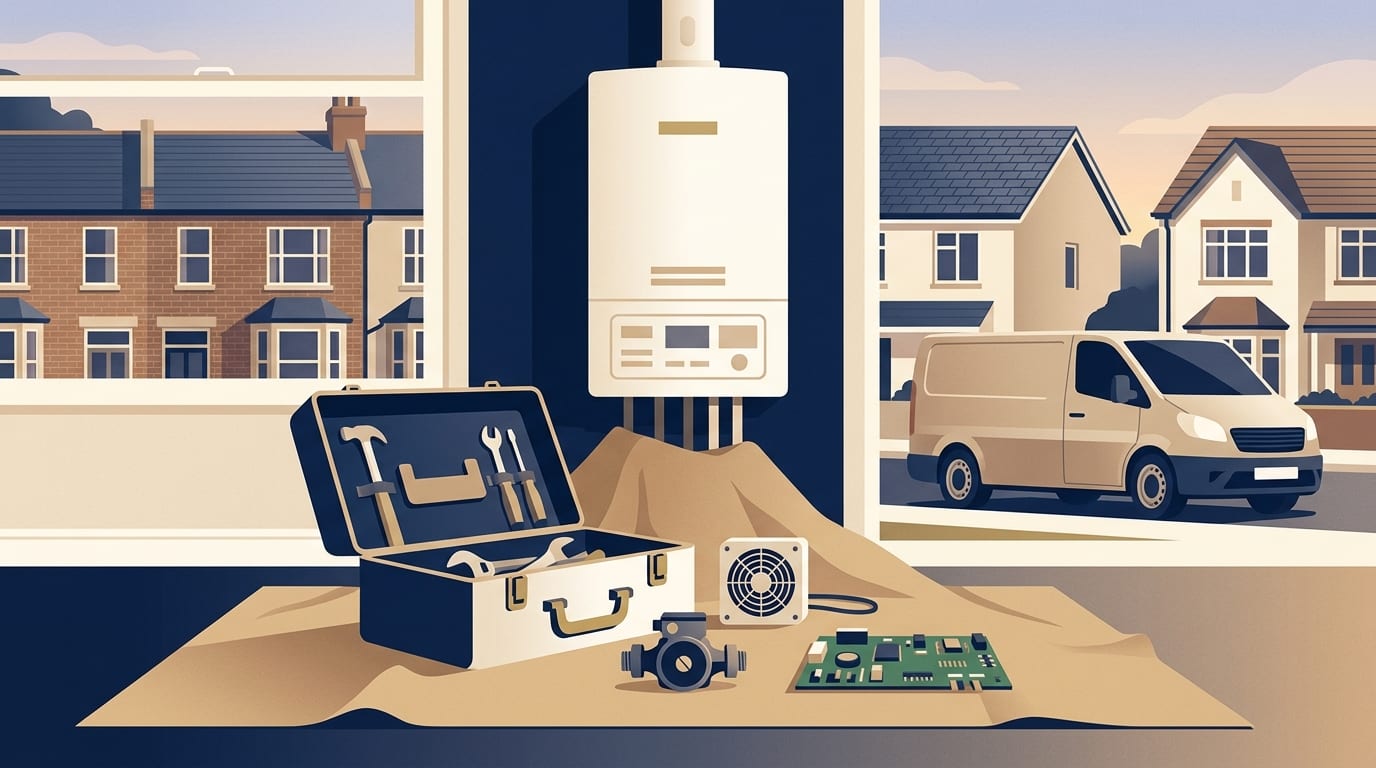
The thermostat or sensor monitors the water temperature and tells the boiler when to fire up and when to shut down. If this breaks, your boiler might not turn on at all, or it might heat the water too much and trigger a safety shutdown.
The ignition or pilot light sparks the gas to create the flame that heats the water. If the boiler cannot light the gas safely, it will lock out and refuse to run.
The fan blows harmful exhaust gases out of the boiler and through the flue to the outside air. Because this is a critical safety feature, the boiler will not attempt to light the gas if the fan is not working.
The pump pushes the heated water out of the boiler and around your radiators and pipework. If the pump fails, the boiler will get hot very quickly but your radiators will stay cold.
The diverter valve is found in a combi boiler. It switches the flow of hot water between your taps and your heating system. If it gets stuck, you might have hot water but no heating, or hot radiators but freezing water from the tap.
The PCB is the main printed circuit board. It acts as the brain of the boiler, controlling all the other components and safety checks. Replacing a PCB is one of the more expensive repairs because the part itself is costly.
The heat exchanger transfers the intense heat from the gas flame into the water inside the pipes. Over time, limescale and sludge can build up inside it, causing it to crack or fail. This is often the most expensive part of a boiler to replace.
The condensate pipe carries slightly acidic wastewater from the boiler to a drain outside. In very cold weather, the water inside this pipe can freeze and block the flow. The boiler will sense the blockage and shut down safely. Thawing and insulating the pipe is a relatively cheap fix.
Expansion vessel and pressure faults
The expansion vessel is a small tank inside or near the boiler that absorbs the extra pressure created when water heats up and expands. A typical boiler pressure is about 1.0 to 1.5 bar when the system is cold, often staying under about 2.0 bar when the heating is on hot.
Recharging an expansion vessel with air typically costs £80 to £180. If the vessel is broken and needs replacing, an external or add on vessel costs £180 to £350 to replace. Replacing an internal vessel inside the boiler casing costs £250 to £450. Complex installations can cost £450 to £600 or more. Most of these jobs take one to three hours.
You might have a faulty expansion vessel if you notice any of these signs.
- Pressure that climbs sharply when the heating runs and drops back down when it cools
- Pressure rising towards 3 bar followed by water discharging from the pressure relief valve pipe outside
- A dripping relief valve outlet after the heating has been on
- Needing to repressurise the boiler system every few days or weekly
How engineers charge for repairs
Plumbers and heating engineers typically charge £40 to £70 an hour depending on the work, or £250 to £400 a day for larger jobs. London and the South East cost more.
The way they bill you usually depends on the type of work. Hourly rates suit investigations where the cause of the fault is not yet known. The engineer will charge for their time while they test components and find the problem.
Fixed prices suit straightforward jobs where the exact work is already agreed, such as replacing a known broken fan or fitting a new pump. A fixed price gives you certainty about the final bill, provided no unexpected problems are found once the casing is removed.
Emergency and out of hours repairs
If your boiler breaks down at night, at the weekend or on a bank holiday, you will pay a premium to get it fixed. Emergency or out-of-hours visits typically cost £120 to £300 plus the cost of any parts. In London and the South East, this rises to £150 to £400 plus parts.
Plumbers often charge emergency call-out fees of £60 to £120 just to attend the property quickly, with their normal labour rate charged on top for the time they spend fixing the problem. Always ask exactly what an emergency fee covers before you give the engineer your address.
Who is allowed to repair a gas boiler?
By law, anyone employed to work on gas appliances in homes must be a Gas Safe registered engineer. They must also be competent in the specific type of gas work they are doing, which means their registration must cover domestic gas boilers.
You can check an engineer is registered by asking to see their Gas Safe ID card when they arrive. You can verify the details by calling the Gas Safe Register on 0800 408 5500, checking on their website, or by texting the word Gas followed by the engineer's seven digit licence number to 85080.
You must not attempt to remove the boiler casing yourself. Repairing or replacing parts inside the boiler, such as ignition and pilot light components, is gas work that must be left to a Gas Safe registered engineer. Strange noises such as banging or whistling should be looked at by an engineer as soon as possible.
It is illegal to use a gas appliance you suspect is unsafe. If you think the boiler is unsafe, turn it off and do not use it until a Gas Safe registered engineer has checked it. If you smell gas, call the gas emergency number straight away. You can find more official guidance on gas safety on the Health and Safety Executive website.
Repair or replace your boiler?
When faced with a large repair bill, you have to decide whether to fix the broken part or put that money towards a brand new boiler. A common rule of thumb in the trade is that if a repair costs more than half the price of a new boiler, replacing it is often the better spend.
Replacement usually makes the most sense for boilers over 10 to 15 years old that have suffered a major failure, such as a cracked heat exchanger or a broken PCB. Older boilers are less efficient, and finding spare parts for them becomes harder and more expensive as time goes on.
However, a working, well serviced older boiler is not automatically due for replacement just because of its age. If the fault is minor and the boiler has been reliable, a repair is often the sensible choice. If an engineer tells you your boiler is beyond repair, you can ask them to write down the exact reason so you can seek a second opinion.
To help you weigh up the cost, new combi boilers typically cost £1,800 to £3,000 supplied and fitted in 2026, while system boilers cost £2,500 to £5,000. Heat only boilers cost £2,300 to £4,500, and oil boilers cost £3,000 to £6,000. In London the typical ranges are £2,000 to £3,600 for a combi, £2,800 to £6,000 for a system boiler, £2,600 to £5,400 for a heat only boiler and £3,300 to £6,500 or more for an oil boiler. Manufacturer warranties on new boilers range from 5 to 12 years.
You can read more about what drives these prices in our guide to new boiler installation costs.
Boiler cover or paying per repair?
Many homeowners buy boiler cover to protect against sudden repair bills, paying a monthly or annual fee so they can call out an engineer without paying a large lump sum. A survey of 10,064 homeowners in June 2025 found that boiler cover averages £183 a year, with some packages costing up to £300.
The same survey found that a one off gas boiler service costs £70 to £110, averaging around £79. Where a repair was needed after a service, it cost £156 on average. Because it is uncommon for boilers to need repairs often enough for cover to pay off, paying as you go is likely to be more cost effective than paying hundreds of pounds a year for cover, provided your boiler is in good shape.
An annual service can help head off bigger repair bills by fixing minor faults early, before they cause a breakdown.
Questions to ask before agreeing a repair
Before you tell an engineer to go ahead with a costly repair, make sure you understand exactly what you are paying for. A proper written quote protects you from unexpected charges and gives you a record of what was agreed.
You should ask for at least three written quotes for larger repairs. Check that the quotes include the following details.
- The exact diagnosis of the fault in writing
- The cost of the replacement parts shown separately from the labour charges
- Clear confirmation of whether VAT is included in the final total
- Any guarantee provided on the new part and the workmanship
- How long the repair will take and how soon the parts will arrive
- Whether the initial diagnostic fee is deducted from the final repair bill
Your rights if the repair fails
When you hire a plumber or heating engineer, you are protected by the Consumer Rights Act 2015. Under this law, a trader must do the work with reasonable care and skill. If they have not, you can ask them to fix the problem. They should do this within a reasonable time and without causing you too much inconvenience. If they cannot or will not fix it, you can ask for a partial or full refund.
It is important to understand the difference between a quote and an estimate. A quote is a promise to do the work at an agreed price. The trader cannot charge more unless you agreed to extra work or the quoted price was an obvious mistake. An estimate is the trader's best guess, but the final price must still be reasonable.
If you are unhappy with the repair, put your complaints in writing to the engineer or their company. If you cannot agree on a solution, alternative dispute resolution is a way to settle it without going to court. You can find detailed advice on dealing with poor workmanship on the Citizens Advice website.
Common questions
What counts as an emergency boiler repair?
An emergency is any fault that causes a direct safety risk, severe water damage, or leaves vulnerable people without heating in freezing weather. Smelling gas is a critical safety emergency, and you must call the free gas emergency number on 0800 111 999 immediately, or 0800 002 001 in Northern Ireland. A minor leak or a lack of hot water in summer is inconvenient but usually does not require an out-of-hours emergency call-out.
Can I get a fixed price boiler repair?
Many local engineers and larger repair firms offer fixed price repairs once they know what the fault is. This means you pay one agreed price for the labour and the part, however long the job takes. The engineer usually needs to diagnose the fault first, and the diagnostic visit is usually included in the final bill if the repair goes ahead.
How can I limit damage before the plumber arrives?
If water is leaking from the boiler, turn off the water supply at the internal stop tap. Catch any dripping water in a bucket and put towels down to protect the floor. If water is leaking near electrical fittings and it is safe to reach the consumer unit, switch off the electricity at the mains. Turn the heating off at the controls.
What should I check if I have no heating or hot water?
Before calling an engineer, check that your thermostat is turned up and the boiler has power. Look at the pressure gauge on the front of the boiler to see if it has dropped below 1.0 bar. If you have a prepay gas meter, check it has credit, and test another gas appliance to make sure the gas supply is on. You can read our guide on what to check when your boiler stops working for more safe steps to try.
What to do next
If your boiler has broken down and you need to arrange a repair, take these practical steps to get it sorted safely.
- Turn off the boiler and the water supply if there is an active leak
- Check your warranty documents to see if the boiler is still covered by the manufacturer
- Decide if the fault is a true emergency or if it can wait until normal working hours to save money
- Ask friends or neighbours for the names of local engineers they trust
- Check the engineer's Gas Safe ID card as soon as they arrive at your property
- Ask for a written quote that separates the cost of parts from the cost of labour
When you are ready to get the fault diagnosed and fixed, you can find a plumber near you using our directory to read customer reviews and compare local businesses.
Find a top rated plumber near you
4,869 plumbers across the UK, each ranked on their Google rating and the number of reviews behind it. Start with your county: