The best single step you can take for central heating maintenance is booking an annual boiler service by a Gas Safe registered engineer before winter arrives. Heating engineers are at their busiest when the cold weather sets in, so acting early helps you avoid a breakdown when you need warmth most. The rest of the preparation is a handful of simple checks you can carry out yourself.
Why prepare your heating before the cold arrives
Central heating systems often sit idle for months during the warmer parts of the year. When temperatures drop and you demand daily heat, any underlying faults are suddenly exposed. This sudden demand is exactly when heating engineers receive the most emergency call outs.
By running through a short checklist in autumn, you give yourself time to fix minor issues before they turn into a total loss of heating. This saves you from paying premium rates for an emergency response on a freezing evening.
The core of this preparation is a professional service. Which? reports that around half of people do not get their boiler serviced every year. Skipping this puts your system at a higher risk of failing in freezing weather. It also leaves you vulnerable to safety risks that only a registered professional can spot.
Preparing early is not just about the boiler itself. It involves making sure your radiators can distribute heat properly and checking that external pipes are protected against frost. A few basic checks will confirm whether your system is ready to run efficiently or whether you need to book an engineer while their diary still has space.
Book the boiler service now
Arranging a professional service is the most effective way to keep your central heating reliable. A Gas Safe registered engineer should carry out the service. The Health and Safety Executive advises that gas appliances, flues and pipework are regularly maintained and serviced at least annually.
An annual service is the best way to keep a boiler in good working order. Missing it will, in most cases, invalidate your manufacturer warranty. If a part fails during winter and the warranty is no longer valid, you may have to pay for the repair yourself.
Never attempt to service gas appliances yourself. It is illegal and highly dangerous. You can check an engineer is qualified by asking for their Gas Safe ID card when they arrive, or by checking the Gas Safe Register website or phone line. Their ID card shows exactly which types of appliance they are qualified to work on.
Under the Consumer Rights Act 2015, any service must be carried out with reasonable care and skill. If the engineer does a poor job or leaves the boiler in a worse state, you can ask for the work to be put right at no extra cost.
A service is usually a fixed price job. The table below shows the cost of a standard service, which does not include any repairs that result.
|
Item |
What to expect |
|---|---|
|
Annual boiler service |
£70 to £110 |
|
Repairs found during the service |
Not included in the service price |
|
How often |
At least once a year |
The £70 to £110 figure is from Which? in October 2026, and your local quotes will differ. You can read more about what a boiler service costs to understand exactly what the engineer will do during the visit.
Weighing a repair against a replacement
If your boiler is very old and struggling, an annual service might uncover faults that are expensive to fix. You will need to weigh the cost of a repair against the price of a full replacement before the winter weather sets in. Heating engineers usually quote a fixed price for a new boiler, which depends on whether it is a direct swap or a change of boiler type.
If an engineer declares the boiler beyond repair, always ask for a written explanation. You want to avoid being sold a replacement when a simple fix would do.
Ask for the repair cost in writing and get a second quote before you agree to a replacement.
Check the boiler pressure gauge
Your central heating system needs the correct water pressure to circulate hot water around your radiators. You can check this by looking at the pressure gauge on the front of your boiler or underneath it. When you are repressurising the system, the gauge should usually sit around one bar.
It is normal for pressure to drop after the heating has been off for a long time. It will also drop after you bleed your radiators, because you are letting trapped air out of the system. If the gauge shows a low reading, check your boiler manual for the safe user steps to top up the water.
If you top up the system and the pressure keeps dropping again shortly afterwards, you may have a leak. This might be a visible drip from a radiator valve, or it could be a hidden issue under your floorboards or inside the boiler itself.
Do not keep topping up a system that constantly loses pressure. Instead, contact a heating engineer to find and fix the fault. You can learn more about what pressure a boiler needs and how to read the gauge correctly.
Bleed and test the radiators
Trapped air stops hot water from filling your radiators completely. This leaves them cold at the top and warm at the bottom. Testing your radiators before winter helps you find these cold spots.
Turn your central heating on and let it run for a while. Walk around your home and carefully feel the top and bottom of each radiator. If the top feels noticeably cooler than the bottom, the radiator needs bleeding to release the trapped air.
You can bleed a radiator yourself using a radiator key. Follow these safe steps to clear the air:
- Make sure the central heating is turned off and the radiators are completely cool.
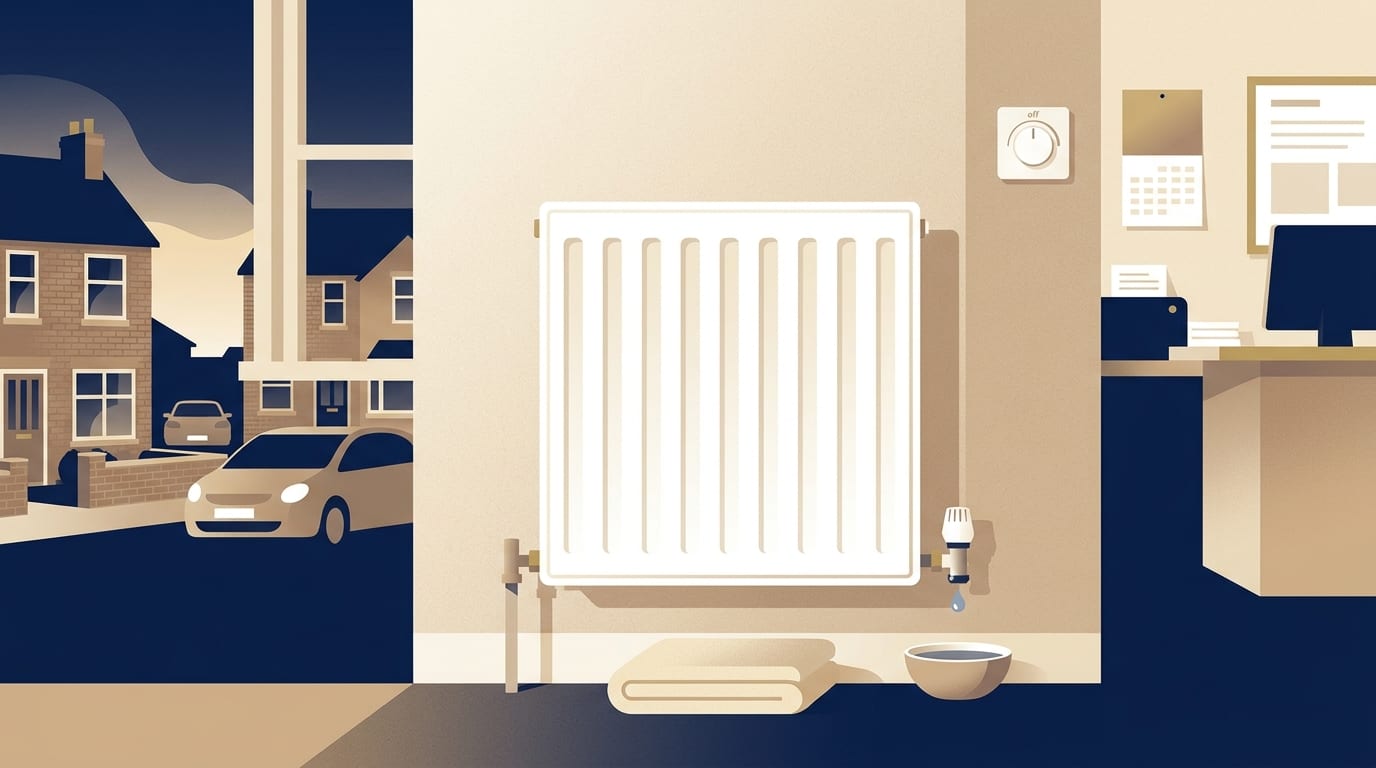
- Place a thick cloth or a small container directly under the radiator valve to catch any drips.
- Insert the radiator key into the square valve at the top of the radiator.
- Turn the key slowly anti-clockwise until you hear a hissing sound as the air escapes.
- Close the valve firmly clockwise as soon as water begins to drip out.
Once you have bled all the affected radiators, go back and check the boiler pressure gauge. Releasing the air will lower the pressure in the system, so you will likely need to top it up again to bring it back to around one bar.
If your radiators are hot at the top but cold at the bottom, bleeding will not help. This can point to a build up of sludge in the system, which needs a heating engineer to look at.
Protect pipes and the condensate pipe
Modern condensing boilers have a plastic condensate pipe that carries acidic waste water away into a drain. This is usually a white or grey plastic pipe that runs from the bottom of the boiler and out through an external wall. If this pipe runs outside your house, it is fully exposed to freezing temperatures.
When the water inside it freezes solid, the boiler will automatically shut down for safety, leaving you with no heating or hot water. You can prevent this by insulating any external condensate pipe before the frost arrives. Wrap the pipe in weatherproof pipe foam, which you can buy from most hardware shops.
If your heating does fail during a cold snap, check the condensate pipe before you call an engineer. If the pipe has frozen, you can thaw an easily reached one with warm, never boiling, water.
You should also check that your main stop tap is working and that any water supply pipes in unheated areas like lofts or garages are insulated. A burst pipe in winter causes severe water damage, so knowing where to turn off your water mains quickly is vital.
Fit and test a carbon monoxide alarm
Carbon monoxide is a colourless and odourless gas that can leak from faulty heating appliances. Every year around 7 people die from gas related carbon monoxide poisoning. The Health and Safety Executive strongly recommends fitting alarms as an early warning precaution, though they do not replace regular maintenance and safety checks by a Gas Safe registered engineer.
If you live in Scotland, you legally need a carbon monoxide detector in your home. Elsewhere in the UK, the Health and Safety Executive strongly recommends one. Choose an audible alarm.
Look for a detector that meets British Standard EN 50291 and carries a British or European approval mark, such as a BSI Kitemark. Which? found in 2022 that four in ten models it reviewed did not work as they should, and it has found dangerous unbranded models sold online. Always buy a tested, branded alarm from a reputable retailer.
Once fitted, test the alarm regularly using the test button. You must also check the expiry date printed on the back or side of the unit. The sensors degrade over time, so an expired alarm will not protect you and must be replaced.
Know your emergency steps
Winter puts extra strain on older heating systems, so you need to know exactly what to do if you suspect a serious gas fault. The symptoms of carbon monoxide poisoning include:
- Headaches
- Breathlessness
- Dizziness
If you suspect poisoning, leave the property immediately and seek medical help.
If you smell gas in or around your home, the rules are clear. Open your doors and windows to ventilate the property. Shut off the gas supply at the meter control valve, but only if you know where it is and can reach it safely.
Call the National Grid Gas Emergency Freephone on 0800 111 999. It is illegal to use a gas appliance you suspect is unsafe, so turn it off and leave it alone until a Gas Safe registered engineer has checked it.
If you or someone in your home is vulnerable, consider signing up to the Priority Services Register. This is a support service run by energy networks. In an emergency situation where your supply is cut off, customers on the register can receive temporary cooking and heating appliances as well as warm blankets.
If you rent your home
Tenants have different responsibilities when it comes to central heating maintenance. Landlords are responsible for the gas safety of the appliances they provide.
Renters should ask their landlord to arrange the annual check. Landlords must arrange an annual gas safety check by a Gas Safe registered engineer for all gas appliances they provide. They must also give you a copy of the gas safety record once the check is complete. Keep it somewhere safe.
While the landlord handles the servicing, you can still perform the basic user checks. You can bleed the radiators if they have cold spots, insulate the external condensate pipe to prevent freezing, and regularly test the carbon monoxide alarms. If you notice the boiler pressure keeps dropping, report it to your landlord quickly so they can send an engineer to find the leak.
What to do if the heating fails in winter
Even with careful preparation, a boiler can still break down when the weather turns freezing. If you wake up to cold radiators, stay calm and run through a few basic checks before you pay for an emergency call-out.
First, check the boiler pressure gauge. If the reading is well below around one bar, follow your boiler manual for the safe user steps and see if the boiler fires up. Next, if temperatures outside are below freezing, inspect the external condensate pipe. If it is frozen, thawing it with warm, never boiling, water and then following your boiler manual to restart it might solve the problem.
If you have checked the pressure and the pipes and the boiler still refuses to work, you will need a professional. Read our guide on what to check before calling an engineer to make sure you have not missed a simple fix like a tripped electrical switch or an empty pre-payment gas meter.
Common questions
Why does my boiler pressure keep dropping?
Pressure drops naturally over long periods or when you bleed your radiators. However, if you top it up and it drops again quickly, you likely have a leak in the system. You will need a heating engineer to locate and repair the fault.
Can I service my gas boiler myself?
No, DIY gas work is illegal and highly dangerous. By law, only a Gas Safe registered engineer is permitted to remove the casing and work on the internal components of a gas boiler. Having your boiler and gas appliances serviced annually by a professional is the best way to avoid potential problems arising.
What happens if a condensate pipe freezes?
When the external plastic condensate pipe freezes solid, the waste water backs up into the boiler. The boiler will automatically shut down for safety, leaving you with no heating until the pipe is thawed.
Are carbon monoxide alarms legally required?
If you live in Scotland, you legally need a carbon monoxide detector in your home. In the rest of the UK the Health and Safety Executive strongly recommends one as an early warning, though it does not replace servicing.
How often should a boiler be serviced?
The Health and Safety Executive advises that gas appliances are serviced at least annually. Having appliances serviced annually is the best way to avoid potential problems arising, and missing a service will in most cases invalidate the warranty.
Your next steps
Getting your central heating ready for winter comes down to planning ahead and spotting small issues early. Work through this checklist before the cold weather sets in:
- Book an annual service with a Gas Safe registered engineer.
- Check the pressure gauge is sitting around one bar.
- Turn the heating on and bleed any radiators with cold spots at the top.
- Insulate your external condensate pipe with weatherproof foam.
- Check that your carbon monoxide alarm is in date and tests properly.
- Note down the 0800 111 999 gas emergency number.
Taking these steps now means you are far less likely to be left waiting for an engineer in a freezing house. If you do need a professional for a service or a repair, make sure you check their credentials carefully. You can use our directory to find a plumber near you.
Find a top rated plumber near you
4,869 plumbers across the UK, each ranked on their Google rating and the number of reviews behind it. Start with your county: