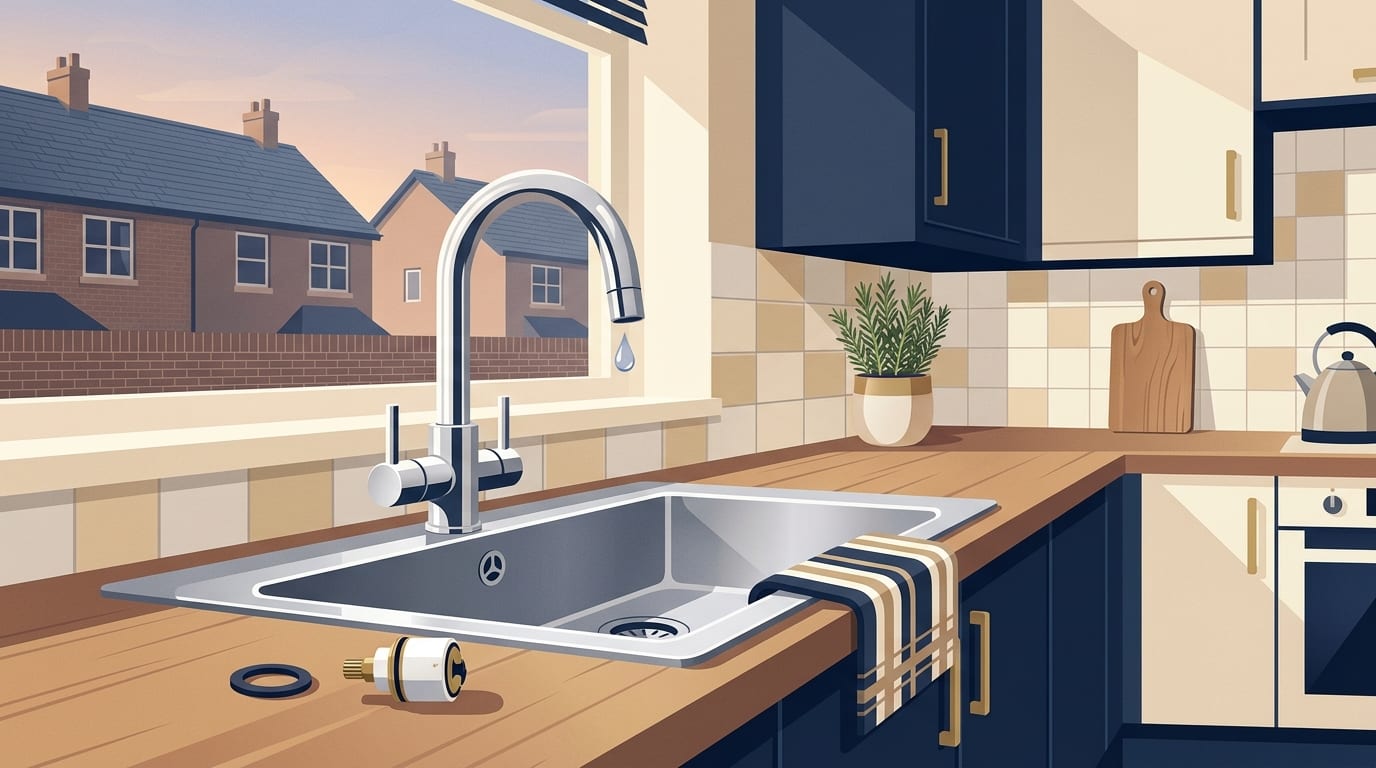
Most drips come from a worn or limescaled washer in older taps or a worn ceramic cartridge in mixer and lever taps. The replacement parts are cheap, and a plumber usually fixes a dripping tap in under an hour. Fixing it quickly stops water waste and prevents sink staining.
Why taps drip
A dripping tap is usually caused by a rubber washer clogged with dirt or limescale so it no longer seals properly. In a single lever tap, which controls both hot and cold water, the problem is often a worn or clogged ceramic cartridge. Other common reasons include a cracked or brittle washer, limescale build-up inside the tap, a damaged O-ring, a corroded valve seat or high water pressure.
A dripping tap left unfixed can waste thousands of litres a year and stain the basin. The continuous drip can also cause wear to the tap mechanism over time, making a simple repair more difficult later.
In winter, the risks increase. You should fix dripping taps inside and out to save water and prevent frozen water backing up into the tap. WaterSafe winter advice suggests isolating and draining your outside tap and disconnecting the hose. You should also insulate outside taps and pipes in unheated areas with foam insulation to protect them from freezing temperatures.
Which type of tap you have
Before you can repair a tap, buy parts or ask a plumber for a quote, you must identify how your tap works. Taps fall into a few main categories, and they use different internal parts to control the water flow.
- Traditional taps take several turns to open and close and use a rubber washer.
- Quarter turn and lever taps use a ceramic disc or a ceramic cartridge instead of a rubber washer.
- Mixer taps combine hot and cold water through one spout.
- Single lever mixer taps use one internal ceramic cartridge to control both the temperature and the flow.
- Monobloc taps are a type of mixer tap designed for a single hole in the basin or sink.
- Bridge taps require two holes but join above the sink to mix the water.
Knowing your tap type helps a plumber bring the right parts and ensures you get an accurate price for the repair.
Turn off the water first
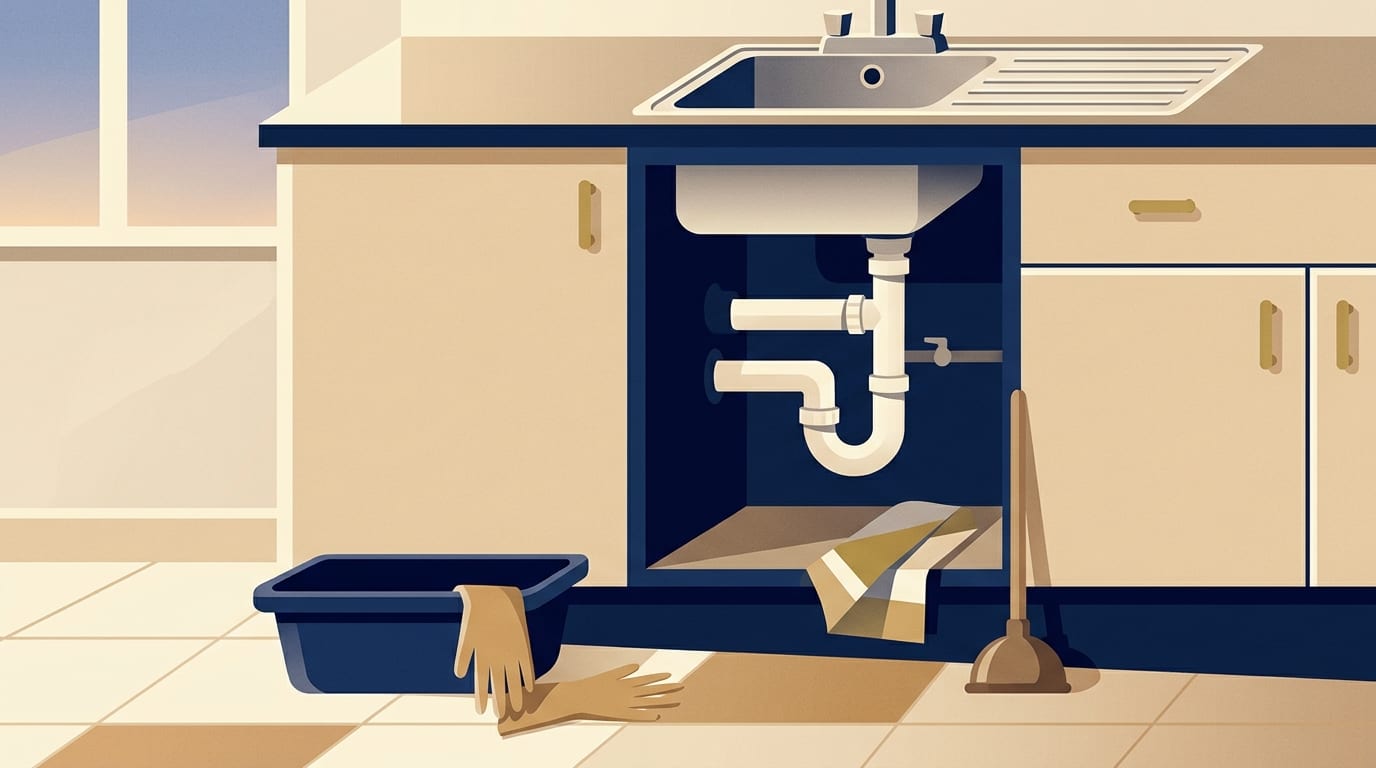
Never dismantle a tap while the water is still on. You must turn off the water supply before you start any inspection or repair. Look under the sink for an isolation valve on the supply pipe leading up to the tap. This is a small valve with a slot in the middle. You can turn this valve with a flat-head screwdriver so the slot sits across the pipe, which shuts off the water to that tap.
If there is no isolation valve under the sink, you must turn off the main water supply at the stop tap. This is often found under the kitchen sink, in a utility room or in the hallway. You need to know where your stop tap is and how to use it in case of a leak.
Once the water is off, open the tap fully to let the remaining water run out of the pipework. Put the plug in the sink and place a towel over the plughole. This ensures that small screws, washers or clips are not lost down the drain while you work.
Taps with a rubber washer
Traditional taps rely on a rubber washer pressing against a metal valve seat to stop the water. Over time, the washer becomes cracked, brittle or clogged with dirt and limescale. When this happens, water slips past the washer and drips out of the spout.
Replacing a tap washer involves taking off the tap handle and unscrewing the brass valve beneath it. You then remove the old washer and fit a new one. Washers come in many different sizes. It is best to take the old washer to a plumbers' merchant to match it exactly. You can then replace the washer following the tap maker's instructions.
If the tap is old, the parts might be seized or corroded. The brass valve can be difficult to grip, and applying too much pressure can damage the tap body or the pipework underneath. If anything is seized, corroded or will not come apart easily, stop and call a plumber rather than force it. If the valve seat inside the tap is pitted or corroded, a new washer will not sit flat, and the tap will continue to drip. A plumber can repair a corroded valve seat using a special reseating tool.
Mixer and lever taps with a cartridge
Modern mixer taps and lever taps do not use rubber washers to control the water flow. Instead, they use a ceramic cartridge or a ceramic disc valve. These parts are highly durable, but when they wear out or get clogged with limescale, the tap will drip.
Fixing this problem means replacing the whole cartridge or disc valve. Reaching it means taking the handle off and undoing the fitting that holds the cartridge, so follow the tap maker's instructions.
You should take the old cartridge to a local plumbers' merchant to ensure you buy the exact replacement. There are dozens of sizes, shapes and pin configurations, and they are not universal. If the retaining nut is heavily limescaled, it can be very difficult to undo without damaging the tap itself. If you struggle to remove the nut or the cartridge, you should stop and call a plumber rather than force it.
When a tap leaks from the base or handle
A tap that leaks around the handle or drips from the base when turned on usually points to a worn O-ring seal. The O-ring sits inside the tap body and keeps water from escaping upwards or outwards through the joints.
Replacing an O-ring requires dismantling the tap spout or handle to access the internal seals. Like washers and cartridges, O-rings cost very little but must be matched exactly for size to create a watertight seal. If you fit an O-ring that is slightly too small, the leak will continue.
If water is leaking near any electrical sockets or appliances in the kitchen, switch off the electricity at the mains if it is safe to reach the consumer unit. Catch the leaking water in a bucket or bowl. If the damage is severe or you are unsure of the source of the problem, hire an approved local plumber to find and fix the fault.
Repair or replace the tap?
A repair is usually cheaper than fitting a new tap. The replacement parts cost very little, and the labour is often just the minimum charge or the first hour of a plumber's time. A repair makes sense for most modern, high-quality or expensive taps where the body is still in good condition.
However, repair is not always the best long-term option. Replacing the tap entirely can be better value if the tap is old, heavily limescaled, corroded or discontinued. If a tap is discontinued, you may not be able to find the exact replacement cartridge. If the brassware is badly corroded, dismantling it for a simple repair might break it entirely.
When deciding whether to repair or replace, consider the cost of labour. If a plumber has to spend two hours trying to dismantle a seized tap and source a rare cartridge, the labour cost will quickly exceed the price of a standard new tap. If you decide to replace the tap, you can ask the plumber to supply it, or you can buy one yourself for the plumber to fit.
What dripping tap repairs cost
Most dripping taps are fixed in under two hours and many in well under one. Plumbers usually charge by the hour or apply a minimum charge for small repairs. A plumber's hourly rate ranges from £25 to £110, with an average of £58. Plumber prices typically include a call-out fee for the first hour of £50 to £120. If a plumber charges a day rate, this is usually £250 to £400. Evenings, weekends and bank holidays carry a premium.
In 2026, a dripping tap repair typically costs £50 to £150 outside London and the South East, with an average of £100. In London and the South East, the typical price is £60 to £180. The final bill depends on the type of repair, the cost of the specific parts, and whether you live in London and the South East.
The table below shows dripping tap repair prices by the type of repair required.
|
Repair type |
Rest of the UK |
London and South East |
|---|---|---|
|
Washer or O-ring replacement |
£50 to £70 |
£60 to £95 |
|
Cartridge replacement |
£60 to £110 |
£80 to £130 |
|
Valve or valve seat repair |
£90 to £140 |
£120 to £150 |
These are typical published prices for 2026 including VAT, and local quotes will differ.
The parts themselves are inexpensive. A washer or O-ring costs £1 to £5. A ceramic cartridge is £10 to £30, and a ceramic disc valve is £15 to £40. When you ask a plumber for a price, check whether VAT and the cost of the replacement parts are included in the figure they give you.
What new tap fitting costs
If your tap is beyond repair, a plumber can remove it and fit a new one. A standard like-for-like swap usually takes 30 minutes to an hour. Wall-mounted taps or corroded pipework can take two hours or more to replace, which pushes the labour cost up.
A standard like-for-like swap typically costs £60 to £130 in labour outside London, and in London and the South East the total runs roughly £80 to £300. Supply and fit, where the plumber provides the tap and handles the installation, typically costs £80 to £250. A replacement tap itself costs £30 to £350 to buy.
The table below shows the labour cost to fit different types of taps.
|
Tap type |
Rest of the UK |
London and South East |
|---|---|---|
|
Pillar, mixer or monobloc |
£50 to £100 |
£75 to £150 |
|
Bridge |
£75 to £120 |
£100 to £175 |
|
Wall-mounted |
£150 to £200 |
£150 to £300 |
These are typical published prices for 2026 including VAT, and local quotes will differ.
If you are buying the tap yourself, expect to pay £30 to £100 for a pillar tap, £40 to £100 for a mixer tap, and £40 to £150 for a monobloc tap. Wall-mounted taps cost £100 to £220 to supply, and bridge taps are £100 to £250. If you are comparing quotes for a new installation, it helps to know what to check before hiring a plumber. If you are having other plumbing work done at the same time, knowing how call-out charges usually work will help you budget.
When to call a plumber
You should call a plumber if you cannot turn off the water supply or if the tap parts are seized and will not unscrew. Forcing corroded brassware can split the pipework under the sink and cause a serious leak. If you have a dripping tap that you cannot fix, you need a professional.
There is no legal licence for general water plumbing in the UK. The water company is responsible for the main and the pipe up to the property boundary, but the property owner is responsible for pipes on their land and inside the building. Because general plumbing is not legally regulated in the same way as gas, checking a plumber's qualifications and approved scheme membership matters.
You can use WaterSafe to find a competent and qualified plumber. WaterSafe is a free online directory and national accreditation body for plumbers, water supply pipe installers and other water services specialists. Its approved plumbers belong to the APHC, CIPHE, SNIPEF or WIAPS approved contractor schemes. They are trained in the Water Fittings Regulations and should hold a recognised Water Fittings Regulations qualification. Approved contractors issue Certificates of Compliance showing that the work meets legal requirements.
Under the Consumer Rights Act 2015, a service must be carried out with reasonable care and skill. If a plumber fits a tap poorly and it leaks, you can ask for the poor work to be put right at no extra cost. Services arranged by phone, online or at home usually carry a 14-day cooling-off period, but this does not automatically apply to urgent repairs you have asked for. If you have a dispute with a tradesperson, you can seek guidance from Citizens Advice.
Be cautious of common problems in the plumbing trade:
- Emergency call outs where no price is given before attendance.
- Call handling firms that pass jobs on at inflated rates.
- Hourly work that drags on to increase the final bill.
- Heavily marked up prices for cheap replacement parts.
- Large cash payments demanded up front with no paperwork provided.
- Choosing a tradesperson on price alone without checking their credentials.
A reputable plumber will explain the fault clearly, provide a proper invoice, and give you a fixed price quote for defined jobs.
Common questions
How to fix a leaking tap
To fix a leaking tap, you must first turn off the water supply at the isolation valve or stop tap. You then remove the tap handle and unscrew the internal valve to replace the worn washer, O-ring or ceramic cartridge. Always take the old part to a plumbers' merchant so you can buy the exact match.
How to change a tap washer
Turn off the water at the isolation valve or stop tap and open the tap to let the remaining water out. Changing the washer means taking the top of the tap apart, so follow the tap maker's instructions and take the old washer to a plumbers' merchant to match it. If anything is seized, corroded or will not come apart easily, stop and call a plumber.
Why is my mixer tap dripping?
A mixer tap usually drips because the internal ceramic cartridge is worn out, cracked or clogged with limescale. Unlike traditional taps, mixer taps do not have rubber washers. You will need to replace the entire ceramic cartridge inside the tap body to stop the drip.
What is a tap cartridge replacement?
A tap cartridge replacement involves removing the faulty ceramic cartridge from a mixer or lever tap and putting a new one in its place. Cartridges control the flow and temperature of the water. They cost between £10 and £30 and are specific to the make and model of your tap.
Replacing a kitchen tap
Replacing a kitchen tap is a good option if the old tap is heavily corroded, badly limescaled or discontinued. A standard like-for-like swap usually takes a plumber 30 minutes to an hour. Labour for a like-for-like swap typically costs £60 to £130 outside London, plus the cost of the tap, or £80 to £250 if the plumber supplies the tap.
Next steps
Before you hire someone to repair or replace your tap, follow this checklist to ensure you get a fair price and a proper job.
- Turn off the isolation valve under the sink to stop the drip and limit water waste.
- Put the plug in the sink and a towel over the plughole so small parts are not lost.
- Check if your tap is traditional, a mixer or a lever type to help the plumber bring the right parts.
- Decide if you want a repair or a full tap replacement.
- Get at least three quotes in writing that show labour, materials, VAT, waste disposal, any call-out fee and timescales.
- Ask if the quote is a fixed price, as an estimate is not a guarantee of the final bill.
- Check that your plumber is approved by WaterSafe or a recognised scheme.
Fixed prices suit straightforward jobs like fitting a new tap, while hourly rates suit fault finding. Ask the plumber if their quote includes the cost of the replacement parts or if you need to supply them. Keep any paperwork and receipts safe so you have a record for the warranty. When you are ready to get the job done, you can find a plumber near you to fix the drip and put things right.
Find a top rated plumber near you
4,869 plumbers across the UK, each ranked on their Google rating and the number of reviews behind it. Start with your county: