A CCTV drain survey involves feeding a small camera on a flexible rod or a robotic crawler through your drains to show the condition of the pipes. A typical survey in 2026 costs somewhere between about £90 and £500, with an average of £250. A basic inspection to look at a blockage is cheaper than a full survey that comes with a detailed written report.
What a CCTV drain survey is
Most drainage pipes are buried deep underground or hidden beneath concrete driveways. In the past, finding a fault meant digging long trenches to expose the pipework, which caused major disruption and cost a lot of money. A CCTV survey changes this by letting a drainage engineer look directly inside the system without lifting a single paving slab.
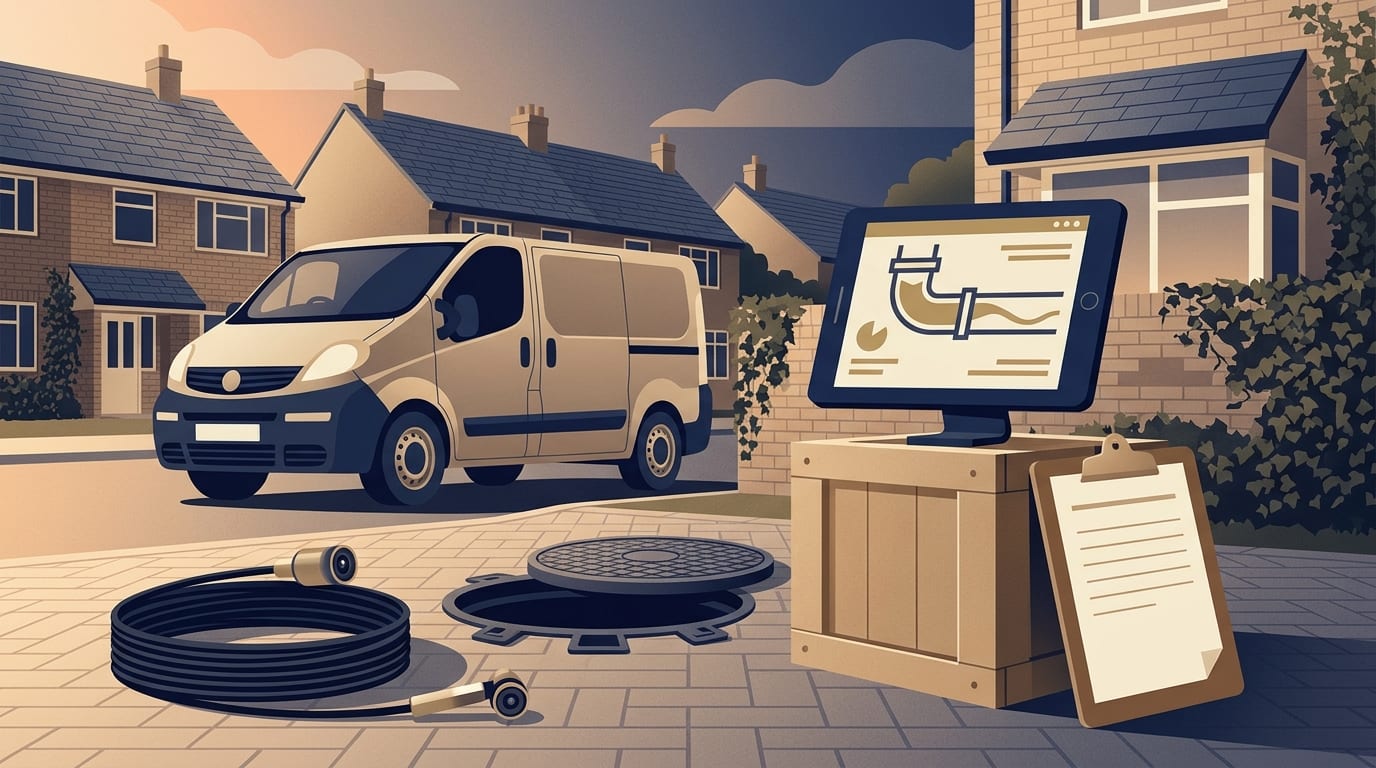
The engineer accesses your drains through an existing manhole or inspection chamber. They feed a high-definition camera into the pipe, which sends live video footage back to a monitor above ground. The camera is surrounded by bright LED lights to illuminate the dark, wet environment, allowing the engineer to see exactly what is happening inside.
For standard household drains, the engineer usually uses a push camera attached to a stiff but flexible rod that can navigate around bends. If you have very large pipes or the survey involves a commercial sewer, they might send down a remote-controlled robotic crawler instead. The footage reveals the exact location and cause of any problem, from a simple build-up of fat to a collapsed pipe or invasive tree roots.
What a drain survey costs
The amount you pay depends on the size of your property and the level of detail you need. A quick look to find a blockage costs far less than a fully mapped survey of a large system. The table below shows typical average prices for different types of survey in 2026.
|
Type of survey |
Average cost |
|---|---|
|
Basic blockage survey |
£90 |
|
Basic drain and sewer inspection |
£150 |
|
Locating blockages with CCTV |
£250 |
|
Full survey with mapping |
£350 |
|
Full survey with robotic crawler |
£350 |
|
Full survey with push camera |
£500 |
These are typical 2026 prices, and local quotes will differ based on your location and the firm you hire. Estimates vary, and some 2026 price lists place the typical range for a standard CCTV drain survey between £120 and £350.
Labour fees are generally higher in London and the South East, which will push local quotes towards the upper end of these price ranges. If you live in a larger property, a full survey usually costs between £350 and £450 because there is a lot more pipework for the engineer to cover. You should also expect to pay more if you book an emergency survey outside normal working hours, as this will carry an additional call-out fee.
What the drain survey report includes
If you pay for a basic blockage survey, the engineer will usually just look at the screen and give you a verbal explanation of the problem. If you pay for a full survey, the price includes a comprehensive written report. This document is a formal record of your drainage system's condition, and a full written report includes:
- Pipe diameters and the materials they are made from
- Invert levels, which show the exact depth of the pipe floor
- The direction of the water flow and current drain usage
- Video footage and still images of the pipe interior
- A site plan showing the location of all the manholes
This level of detail is necessary if you are planning building work, as architects and builders need to know exactly where the pipes run and how deep they are. It is also vital if you are claiming on your home insurance. Insurers usually require evidence such as CCTV footage when a claim is made for sudden drain damage.
If you book a pre-purchase survey, the report goes even further. It covers the condition of the manholes, lists any specific defects found, and recommends remedial work with estimated repair costs.
How long a drain survey takes
A standard drain survey takes about two hours to complete on average. The exact time depends heavily on why the survey is being done and how much pipework needs to be inspected. A quick check of a single pipe is much faster than mapping an entire network.
A basic blockage survey is usually the fastest option and takes about one hour. A basic drain and sewer inspection takes one to two hours, which matches other estimates of one to two hours for a standard job. If the engineer is specifically locating hidden blockages or using a robotic crawler, the work will take one to three hours.
Full surveys take the longest because the engineer must record every detail for the written report. A full mapping survey or a comprehensive push camera survey takes three to four hours. For larger properties with extensive drainage systems, the process can take up to four to six hours.
When a survey is worth paying for
You do not need a CCTV survey every time a sink drains slowly or a toilet clogs. Most minor blockages can be cleared quickly with a plunger or a drain snake. A survey is worth the money when standard unblocking methods fail, or when you have recurring or hidden drainage problems and the fault location is unknown. There are several clear warning signs that suggest your drains need a closer look:
- Persistent bad smells inside the house or out in the garden
- Slow drainage or water backing up into sinks, baths and toilets
- Bubbling noises around plugholes when water drains away
- A history of drainage problems at the property
Older properties are particularly vulnerable to drainage faults because they often have fragile clay pipes that crack or collapse over time. If you have mature trees near your drains, a survey is often necessary. Tree roots naturally seek out moisture and will force their way through small pipe joints, causing severe blockages that are impossible to clear without specialist equipment.
You will also need a survey if you are planning to build an extension over or within three metres of a public sewer. A trade contributor notes that this requires an agreement with the utility provider. The water company will usually insist on a CCTV survey before the building work starts and another one after it finishes to prove the sewer has not been damaged.
Buying a home and a drain survey
When you buy a house, you usually pay a surveyor to check the roof, the walls and the foundations. A standard building survey does not cover the underground drainage system. A pre-purchase drain survey fills this gap and tells you exactly what you are taking on.
For a standard property, a pre-purchase survey usually costs between £250 and £350. The buyer usually arranges and pays for this inspection. It is an extra upfront cost, but it can save you from inheriting a collapsed drain that costs thousands of pounds to put right.
If the survey finds a serious defect, the report gives you the evidence you need to renegotiate the purchase price. You can ask the seller to reduce the asking price by the estimated cost of the repairs. Alternatively, you can insist that the seller pays to have the drains fixed before you exchange contracts.
What is not included in the price
The price you are quoted for a CCTV drain survey covers the inspection and the report only. Cleaning, unblocking or repairs are not included unless the quote explicitly says so.
If your drains are heavily blocked with fat, wet wipes or mud, the camera lens will be covered in muck and the engineer will not be able to see the pipe walls. They will have to clear the pipe before they can survey it. Pre-survey cleaning and jetting for severe blockages costs about £100 to £150 and is charged separately.
If the survey finds a simple blockage that the engineer can clear while they are on site, post-survey cleaning or unclogging costs about £100 and takes one to two hours. If the manholes or access points are buried under soil or paving, the engineer will have to dig down to reach them. Difficult access needing excavation will cost an extra £100 to £300.
The survey diagnoses the fault, but it does not fix it. If the footage reveals a broken pipe, you will need to hire a contractor to dig it up and replace it. You can read more about what this involves in our guide to collapsed drain repair cost.
Who is responsible for what the survey finds
When a survey uncovers a broken pipe or a severe blockage, you need to know who has to pay for the repair. The rules depend entirely on where the damaged section of pipe is located.
According to Ofwat, household drains are the property owner's or landlord's responsibility up to the property boundary where they connect to the public sewer. This means you have to pay for any repairs or unblocking on your own land and inside your building.
The situation changes once the pipe crosses your boundary. Private sewers outside property boundaries mostly transferred to sewerage companies as from 1 October 2011. If the survey shows that the problem is in the main sewer, it is normally the water company's job to fix it.
If you suspect the blockage is outside your boundary, you should contact your sewerage company for drain blockages or flooding before you pay for a private survey. You can find more information about this in our guide to dealing with a blocked outside drain. If you have damp patches inside the house, you may also want to read how to detect a water leak.
Your rights when hiring a drainage company
When you hire someone to survey or unblock your drains, you are protected by the Consumer Rights Act 2015. This law states that any service must be carried out with reasonable care and skill. If the engineer does a poor job or fails to provide the written report you paid for, you can ask for the poor work to be put right at no extra cost.
Services arranged by phone, online or at your home usually carry a 14-day cooling-off period. This gives you the right to cancel the contract and walk away. However, this does not automatically apply to urgent repairs that you have specifically asked the company to carry out immediately.
If a drainage company damages your property or refuses to fix a mistake, you should complain to them in writing first. If they do not resolve the issue, you can contact Citizens Advice for guidance on how to enforce your consumer rights.
Questions to ask before booking
The drainage industry has many call-handling firms that advertise online, take your booking, and then pass the job on to a local contractor at an inflated rate. You will often get a better price and clearer communication by dealing directly with a local firm. Before you agree to a survey, ask the company these questions:
- Are you a call-handling service or the firm doing the actual work?
- Is this a fixed quote for the survey, or just an estimate?
- Does the price include a full written report and the video footage?
- Are VAT and call-out charges included in the total price?
- What will you charge for high-pressure jetting if the drain needs cleaning first?
A quote is a fixed price that cannot change without your agreement. An estimate is just a guess and can increase once the job starts. You should also avoid any company that demands a large cash payment up front or refuses to provide proper paperwork.
Common questions
Can a drain survey find every fault?
A CCTV survey is excellent at finding cracks, blockages, tree roots and collapsed sections inside the pipe. However, the camera cannot see through the pipe walls. It will not spot problems hidden in the surrounding soil or in sections of the drainage system that are completely inaccessible.
Do I always need a written report?
If you just want a plumber to find out why your kitchen sink keeps blocking, a basic camera inspection and a verbal explanation is usually enough. You only need a full written report if you are buying a house, making a claim on your home insurance, or applying for a build-over agreement.
Will a drain survey make a mess?
A professional survey is usually a clean process. The engineer feeds the camera through existing manholes, inspection chambers or rodding eyes. There is no need to dig up your garden or driveway unless the access points are buried or completely sealed shut.
Can I do a drain survey myself?
You cannot carry out a proper drain survey yourself. Professional drainage cameras are highly specialised pieces of equipment designed to navigate tight bends and work underwater. Poking a cheap inspection camera down a drain rarely gives a clear picture and you risk getting the equipment stuck in the pipe.
Next steps
If you have a recurring drainage problem or are preparing to buy a new home, you need to gather the right information. These are your next steps:
- Check outside for obvious signs of trouble like overflowing manholes, bad smells or bubbling drains.
- Determine if the problem is inside your property boundary or out in the public sewer.
- Decide if you just need a basic blockage check or a full written report for an insurer or mortgage lender.
- Contact three local drainage companies and ask for fixed quotes that include the report and the video footage.
- Clarify exactly what they charge for high-pressure jetting in case the pipe needs cleaning before the camera can see anything.
Getting a clear view of your drains takes the guesswork out of repairs and stops you paying for work you do not need. When you are ready to get the problem diagnosed, you can find a plumber near you to discuss what kind of survey suits your property.
Find a top rated plumber near you
4,869 plumbers across the UK, each ranked on their Google rating and the number of reviews behind it. Start with your county: